

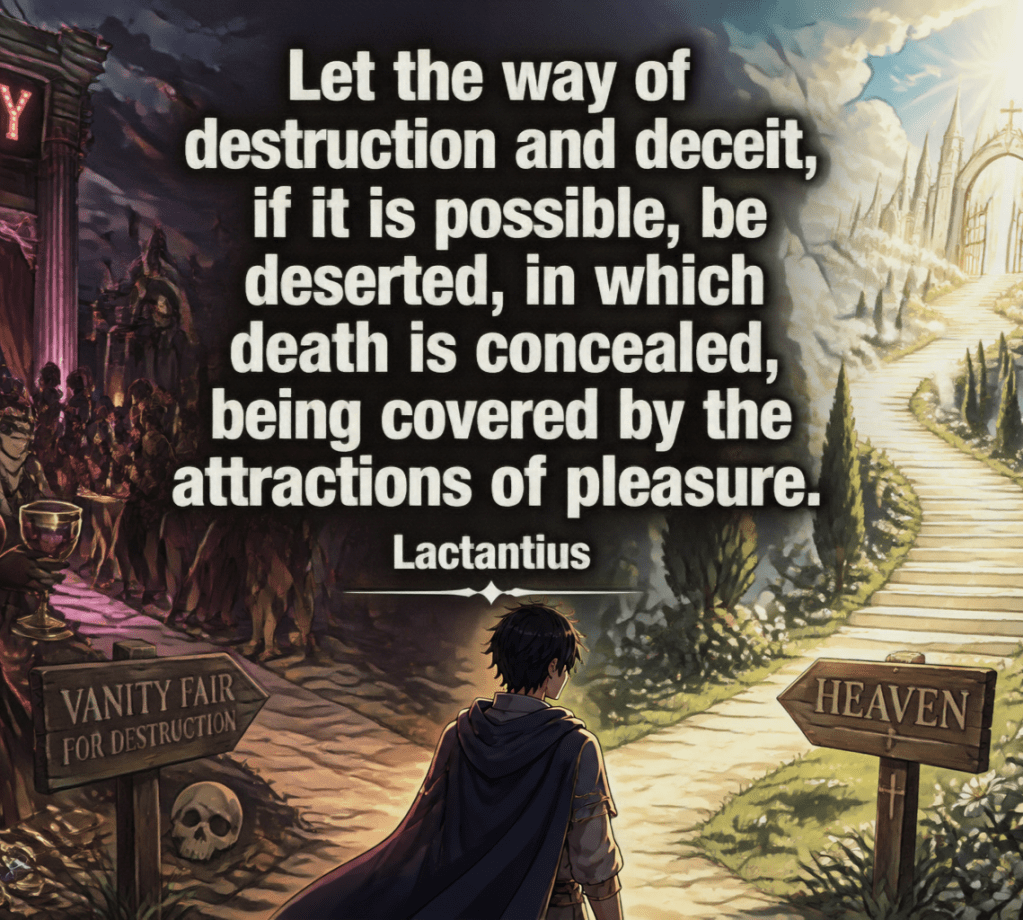
And not only pointed it out, but also went before us in it, that no one might dread the path of virtue on account of its difficulty. Let the way of destruction and deceit, if it is possible, be deserted, in which death is concealed, being covered by the attractions of pleasure.
And the more nearly each one, as his years incline to old age, sees to be the approach of that day in which he must depart from this life, let him reflect how he may leave it in purity, how he may come to the Judge in innocency; not as they do, to whose dark minds the light is denied, who, when the strength of their body now fails, are admonished in this of the last pressing necessity, that they should with greater eagerness and ardour apply themselves to the satisfying of their lusts. From which abyss let everyone free himself while it is permitted him, while the opportunity is present, and let him turn himself to God with his whole mind, that he may without anxiety await that day, in which God, the Ruler and Lord of the world, shall judge the deeds and thoughts of each. Whatever things are here desired, let him not only neglect, but also avoid them, and let him judge that his soul is of greater value than those deceitful goods, the possession of which is uncertain and transitory; for they take their departure every day, and they go forth much more quickly than they had entered, and if it is permitted us to enjoy them even to the last, they must still, without doubt, be left to others. We can take nothing with us, except a well and innocently spent life. That man will appear before God with abundant resources, that man will appear in opulence, to whom there shall belong self-restraint, mercy, patience, love, and faith. This is our inheritance, which can neither be taken away from any one, nor transferred to another. And who is there who would wish to provide and acquire for himself these goods?
Lactantius. 1886. “The Divine Institutes.” In Fathers of the Third and Fourth Centuries: Lactantius, Venantius, Asterius, Victorinus, Dionysius, Apostolic Teaching and Constitutions, Homily, and Liturgies, edited by Alexander Roberts, James Donaldson, and A. Cleveland Coxe, translated by William Fletcher, 7:222–23. The Ante-Nicene Fathers. Buffalo, NY: Christian Literature Company.
 1love1god.com