

Does it not occur to you to reflect and to examine in whose domain you live? on whose property you are? whose is that earth which you till?11 whose is that air which you inhale, and return again in breathing? whose fountains do you abundantly enjoy? whose water? who has regulated the blasts of the wind? who has contrived the watery clouds? who has discriminated the productive powers of seeds by special characteristics? Does Apollo give you rain? Does Mercury send yon water from heaven? Has Æsculapius, Hercules, or Diana devised the plan of showers and of storms? And how can this be, when you give forth that they were born on earth, and that at a fixed period they received vital perceptions? For if the world preceded them in the long lapse of time, and if before they were born nature already experienced rains and storms, those who were born later have no right of rain-giving, nor can they mix themselves up with those methods which they found to be in operation here, and to be derived from a greater Author.
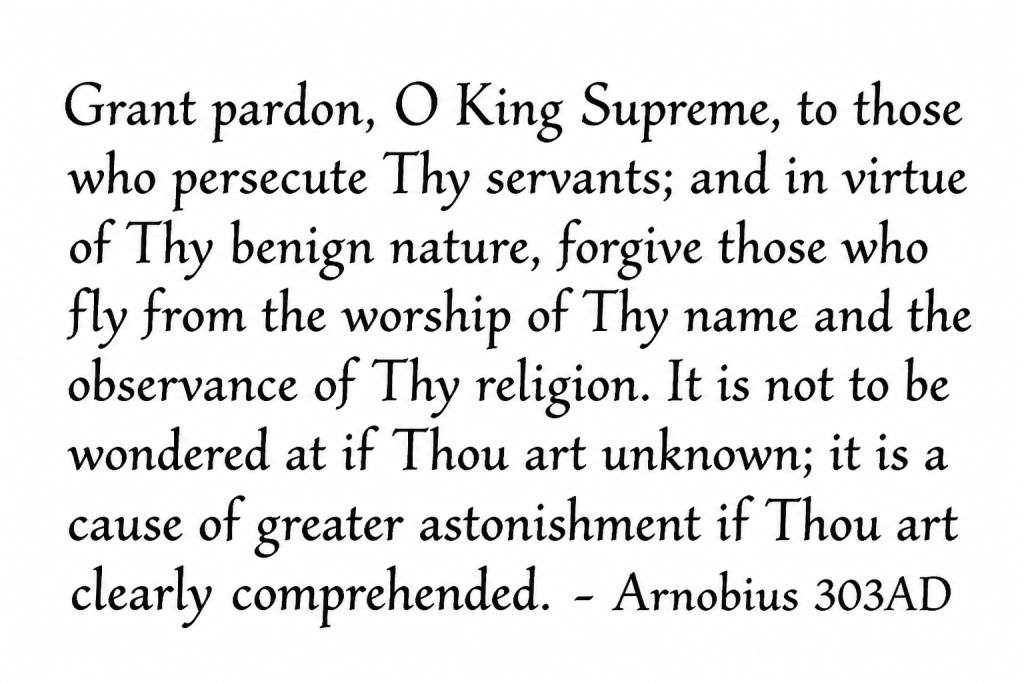
31. O greatest, O Supreme Creator of things invisible! O Thou who art Thyself unseen, and who art incomprehensible! Thou art worthy, Thou art verily worthy—if only mortal tongue may speak of Thee—that all breathing and intelligent nature should never cease to feel and to return thanks; that it should throughout the whole of life fall on bended knee, and offer supplication with never-ceasing prayers. For Thou art the first cause; in Thee created things exist, and Thou art the space in which rest the foundations of all things, whatever they be. Thou art illimitable, unbegotten, immortal, enduring for aye, God Thyself alone, whom no bodily shape may represent, no outline delineate; of virtues inexpressible, of greatness indefinable; unrestricted as to locality, movement, and condition, concerning whom nothing can be clearly expressed by the significance of man’s words. That Thou mayest be understood, we must be silent; and that erring conjecture may track Thee through the shady cloud, no word must be uttered. Grant pardon, O King Supreme, to those who persecute Thy servants; and in virtue of Thy benign nature, forgive those who fly from the worship of Thy name and the observance of Thy religion. It is not to be wondered at if Thou art unknown; it is a cause of greater astonishment if Thou art clearly comprehended.1
But perchance some one dares—for this remains for frantic madness to do—to be uncertain, and to express doubt whether that God exists or not; whether He is believed in on the proved truth of reliable evidence, or on the imaginings of empty rumour. For of those who have given themselves to philosophizing, we have heard that some2 deny the existence of any divine power, that others3 inquire daily whether there be or not; that others4 construct the whole fabric of the universe by chance accidents and by random collision, and fashion it by the concourse of atoms of different shapes; with whom we by no means intend to enter at this time on a discussion of such perverse convictions.5 For those who think wisely say, that to argue against things palpably foolish, is a mark of greater folly.
Arnobius. 1886. “The Seven Books of Arnobius against the Heathen (Adversus Gentes).” In Fathers of the Third Century: Gregory Thaumaturgus, Dionysius the Great, Julius Africanus, Anatolius and Minor Writers, Methodius, Arnobius, edited by Alexander Roberts, James Donaldson, and A. Cleveland Coxe, translated by Hamilton Bryce and Hugh Campbell, 6:420–21. The Ante-Nicene Fathers. Buffalo, NY: Christian Literature Company.

