

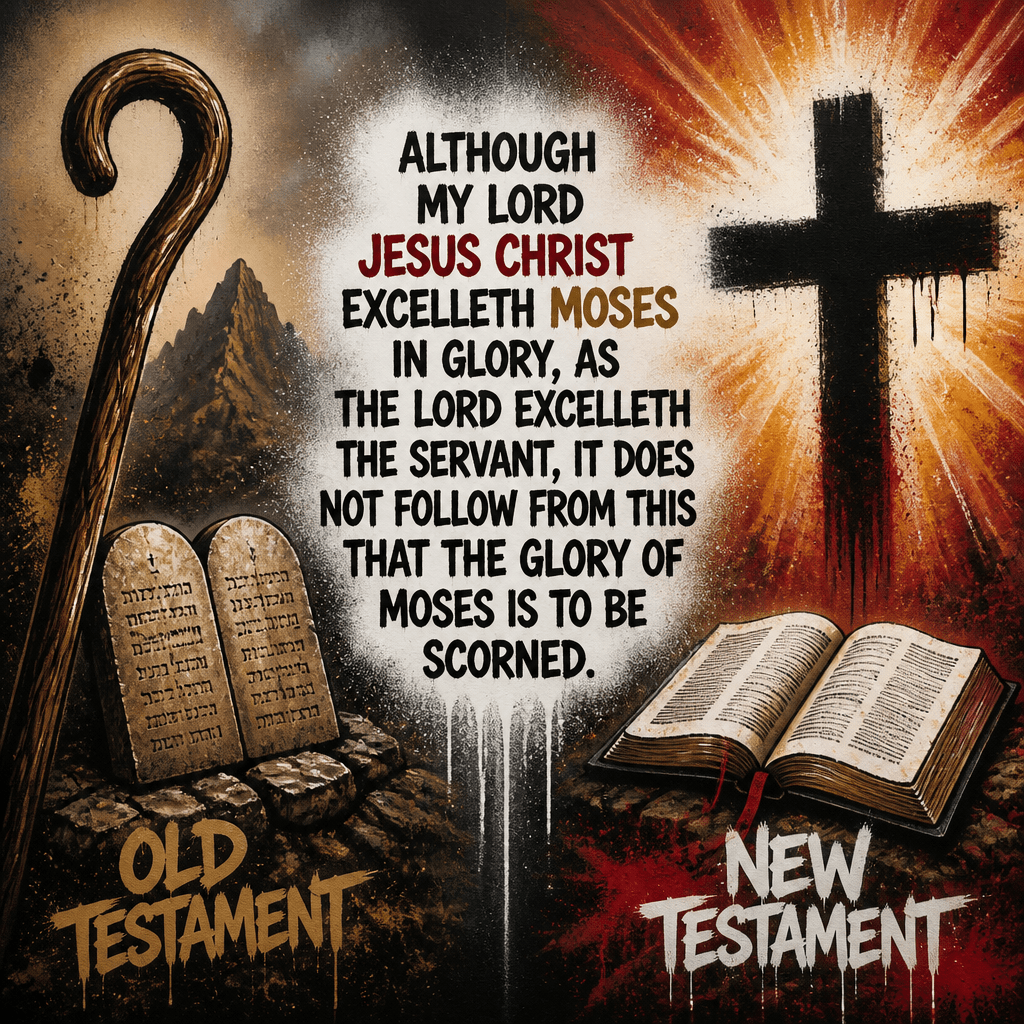
Although, then, the sun has a greater glory than the moon, it does not follow that the moon is thereby reduced to a condition of dishonour. And even thus, too, although my Lord Jesus Christ excelleth Moses in glory, as the lord excelleth the servant, it does not follow from this that the glory of Moses is to be scorned. For in this way, too, we are able to satisfy our hearers, as the nature of the word itself carries the conviction15 with it, in that we affirm what we allege on the authority of the Scriptures themselves, or verily make the proof of our statements all the clearer also by illustrations taken from them. Thus, although a person kindles a lamp in the night-time, after the sun has once risen he has no further need of the paltry light of his lamp, on account of that effulgence of the sun which sends forth its rays all the world over; and yet, for all that, the man does not throw his lamp contemptuously away, as if it were something absolutely antagonistic to the sun; but rather, when he has once found out its use, he will keep it with all the greater carefulness. Precisely in this way, then, the law of Moses served as a sort of guardian to the people, like the lamp, until the true Sun, who is our Saviour, should arise, even as the apostle also says to us: “And Christ shall give thee light.”
Archelaus. 1886. “The Acts of the Disputation with the Heresiarch Manes.” In Fathers of the Third Century: Gregory Thaumaturgus, Dionysius the Great, Julius Africanus, Anatolius and Minor Writers, Methodius, Arnobius, edited by Alexander Roberts, James Donaldson, and A. Cleveland Coxe, translated by S. D. F. Salmond, 6:218. The Ante-Nicene Fathers. Buffalo, NY: Christian Literature Company.

