

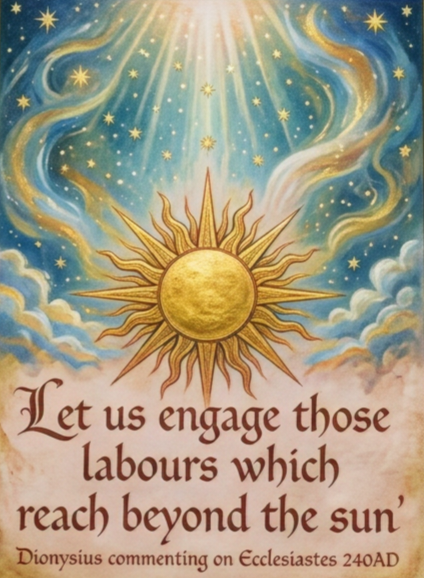
“I made me great works; I builded me houses; I planted me vineyards. I made me gardens and orchards. I made me pools of water, that by these I might rear woods producing trees. I got me servants and maidens, and had servants born in my house; also I had large possessions of great and small cattle above all that were in Jerusalem before me. I gathered me also silver and gold, and the peculiar treasure of kings and of the provinces. I gat me men-singers and women-singers, and the delights of the sons of men, as cups and the cupbearer. And I was great, and increased more than all that were before me in Jerusalem: also my wisdom remained with me. And whatsoever mine eyes desired, I kept not from them; I withheld not my heart from any pleasure.” – Ecclesiastes 2:4-10
You see how he reckons up a multitude of houses and fields, and the other things which he mentions, and then finds nothing profitable in them. FOR NEITHER WAS HE ANY BETTER IN SOUL BY REASON OF THESE THINGS, NOR BY THEIR MEANS DID HE GAIN FRIENDSHIP WITH GOD. Necessarily he is led to speak also of the true riches and the abiding property. Being minded, therefore, to show what kinds of possessions remain with the possessor, and continue steadily and maintain themselves for him, he adds: “Also my wisdom remained with me.” For this alone remains, and all these other things, which he has already reckoned up, flee away and depart. Wisdom, therefore, remained with me, and I remained in virtue of it. For those other things fall, and also cause the fall of the very persons who run after them. But, with the intention of instituting a comparison between wisdom and those things which are held to be good among men, he adds these words, “And whatsoever mine eyes desired, I kept not from them,” and so forth; whereby he describes as evil, not only those toils which they endure who toil in gratifying themselves with pleasures, but those, too, which by necessity and constraint men have to sustain for their maintenance day by day, labouring at their different occupations in the sweat of their faces. For the labour, he says, is great; but the art by the labour is temporary, adding nothing serviceable among things that please. Wherefore there is no profit. For where there is no excellence there is no profit. With reason, therefore, are the objects of such solicitude but vanity, and the spirit’s choice. Now this name of “spirit” he gives to the “soul.” For choice is a quality, not a motion. And David says: “Into Thy hands I commit my spirit.” And in good truth “did my wisdom remain with me,” for it made me know and understand, so as to enable me to speak of all that is not advantageous under the sun. If, therefore, we desire the righteously profitable, if we seek the truly advantageous, if in is our aim to be incorruptible, let us engage those labours which reach beyond the sun. FOR IN THESE THERE IS NO VANITY, and there is not the choice of a spirit at once inane and hurried hither and thither to no purpose.
Dionysius of Alexandria. 1886. “Exegetical Fragments.” In Fathers of the Third Century: Gregory Thaumaturgus, Dionysius the Great, Julius Africanus, Anatolius and Minor Writers, Methodius, Arnobius, edited by Alexander Roberts, James Donaldson, and A. Cleveland Coxe, translated by S. D. F. Salmond, 6:112. The Ante-Nicene Fathers. Buffalo, NY: Christian Literature Company.
“Therefore, my beloved brethren, be ye stedfast, unmoveable, always abounding in the work of the Lord, forasmuch as ye know that your labour is not in vain in the Lord.” – 1 Corinthians 15:58
Isaiah 49:6 and Acts 1:6-8! Trust Jesus over meaninglessness and vanity and vexation of spirit! God bless…

