

“And if a man smite his servant, or his maid, with a rod, and he die under his hand; he shall be surely punished. Notwithstanding, if he continue a day or two, he shall not be punished: for he is his money.” – Exodus 21:20,21
If this verse is a troubling verse to you then please stay for a moment. This verse I believe when taking in context is not at all allowing a master to beat his servant/slave to an inch of their lives and if they survive then all is good.
First, notice that if the servant/slave is down for more than 2 days the master gets punished, also. I can only assume that a trial for the punishment would go before appointed judges and thoroughly investigated (See Exodus 18:21,22 and Deuteronomy 1:16,17, 16:18-20, 17:8-13, Deutoronomy 19:15-21 etc etc etc) and the death penalty would be incurred upon the master if it warranted it (Leviticus 24:21).
But I do not believe for a moment this verse is to be taken in the spirit that a master can beat his servant/slave for any arbitrary reason at all (this is assumed without argument by the skeptic!). This is inconsistent with the teaching of Scripture thus far and in totality. It is inconsistent with all these descriptions of how the judges are to judge and the character of God Himself (Psalm 119:68, especially toward Israel when they were enslaved by Pharoah, Exodus 1:11-14, 2:25 and then God tells them that they are to love the foreigners in their land for this very reason Exodus 23:9, Leviticus 19:33,34 etc etc etc) and if we head to the New Testament passages concerning how masters are to treat their servants/slaves under the Roman economy (Colossians 4:1, Ephesians 6:9, for more information concerning NT masters and slaves here is a must read: https://1love1god.com/2024/03/10/when-doing-some-research-on-slavery-in-the-bible-i-found-these-remarks-enlightening/ etc etc etc).
So, it is not consistent with all of Scripture in anyway shape or form to assume that this smiting of a servant/slave is an unjustified use of force (this Hebrew word is not hamas, see https://www.blueletterbible.org/lexicon/h2555/kjv/wlc/0-1/ but rather naka, see https://biblehub.com/hebrew/5221.htm which is the same word used of a father disciplining his son with a rod in Proverbs 23:13,14 and do we need to argue it is arbitrary and in some ungodly/unjustified way, Hebrew 12:4-11).
So, it must be a justified use of force. Let me give one obvious justified use of force that a master would have to implement on a servant/slave. When one servant/slave is physically harming another. This would require a justified use of force. And so now get this! Once you have in your mind that this is a justified use of force, then what God is saying to masters of servants/slaves: you better be darn careful how you use even justified uses of force.
Now, let us look at 2 verses below this one: “And if a man smite the eye of his servant, or the eye of his maid, that it perish; he shall let him go free for his eye’s sake. And if he smite out his manservant’s tooth, or his maidservant’s tooth; he shall let him go free for his tooth’s sake.” – Exodus 21:26,27
Again, we are only talking about justified use of force, and this is what kind of gave me the hint that Exodus 21:20,21 is not about that excessive smiting. The slave goes free if you break something. I do not believe this is just about an eye or a tooth, let alone being beatin to the point of death without breaking an eye or tooth but everything else too. This would be about breaking any bone/organ of the body as we see in the very verse above: “Eye for eye, tooth for tooth, hand for hand, foot for foot…” – Exodus 21:24. God is expecting us to get the point without having to list every organ in our body! The judges (see above) will judge rightly!
So, this CAN NOT be characterized (without some biased, strawmanning and unjustified use of thinking toward the Scriptures) that God is here creating a law that you can beat a servant/slave to the point of almost death. Even if you didn’t have Exodus 21:26,27 you should be able to conclude this, but now even more so with vs 26 and 27.
Anyhow, this is what I have concluded about this very passage in Exodus 21:20,21. I used servant/slave as translations seem to use both but it is clear that this servant/slave is the property of the master from Exodus 21:21 at least for the time. There were differences in a Hebrew servant/slave and servants/slaves that were bought from the nations. A Hebrew servant/slave was only the masters property for a contracted time whereas a servant/slave from the nations were bought I assume for the contract between the seller and the buyer. But get this!
“Thou shalt not deliver unto his master the servant which is escaped from his master unto thee: He shall dwell with thee, even among you, in that place which he shall choose in one of thy gates, where it liketh him best: thou shalt not oppress him.” – Deutoronomy 23:15,16.
GO FIGURE THIS ONE OUT and think about the implications!
I guess this is my 2nd post on slavery in the Bible. I really learned a lot from a faithful pastor’s comments of slavery in the book of Titus that helped me out in so many different areas when it comes to what we as Christians are to do under ungodly political structures and systems (so encouraging):
Update 03/27/2024: “But and if that servant say in his heart, My lord delayeth his coming; and shall begin TO BEAT THE MENSERVANTS AND MAIDENS, and to eat and drink, and to be drunken;” – Luke 12:45
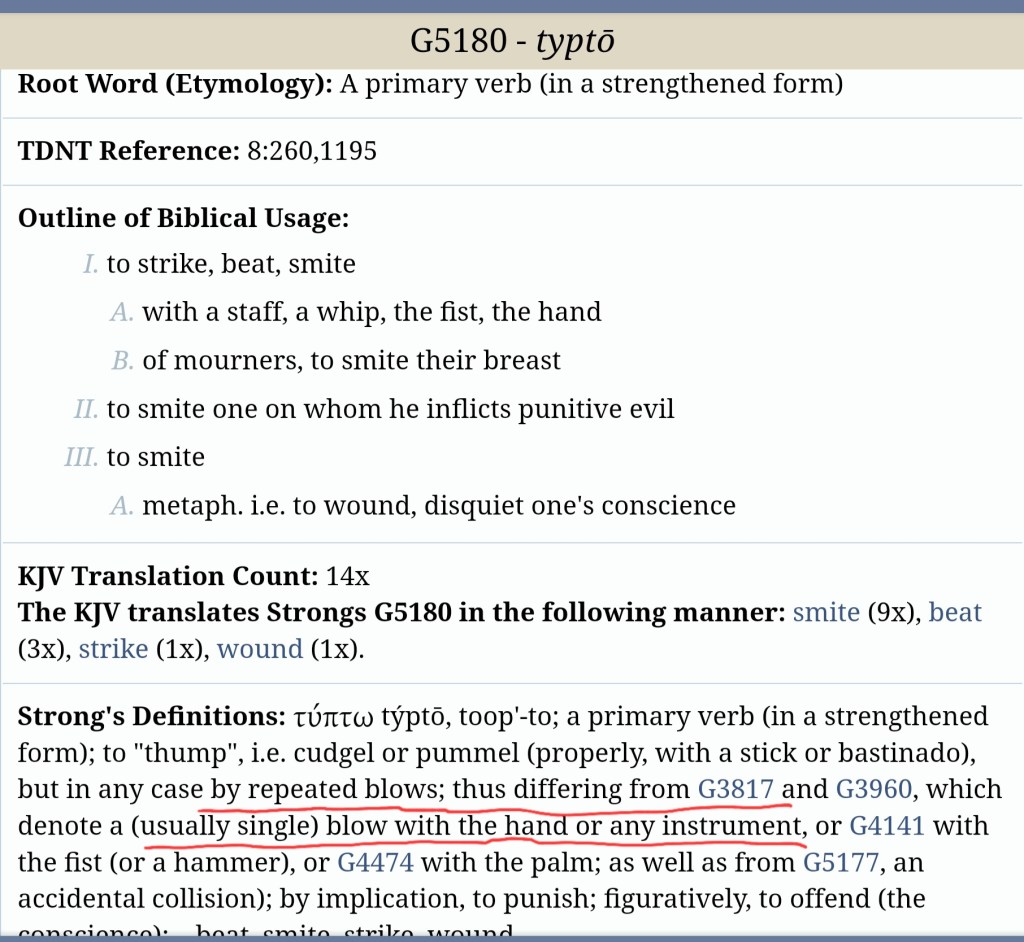
The greek word for “beat” here is typto (Strongs G5180). This is clearly an unjust beating as Jesus says this servant will be judged for this in the next verse. Now, I find it interesting that the greek Septuagint doesn’t use typto (Strongs G5180) in Exodus 21:20 but rather patasso (Strongs G3960) but does use typto in Exodus 21:15 of a child smiting his father. So, the greek translators of the Old Testament used two different words for the smiting/beating in Exodus 21:15,21 even though they are the same Hebrew word. Which gives further evidence that even the Greek translators of the Septuagint (wikipedia dates back to 285 BC, many years before the Masoretic Hebrew text by a thousand years or so) translation of the Old Hebrew may agree with my position here and may give evidence that the original Hebrew may have distinguished between the two though I am no scholar and wish not to make that claim but seemingly possible. In spite of the two translations, it is clear that this understanding is further backed up by the greek even if the OG Hebrew didn’t distinguish between the two. I didn’t come to this conclusion by looking at the greek first but the hebrew and so even just looking at the hebrew and taking all in context gives you the same understanding. This is just further evidence as we look at another early translation into a different language of greek.
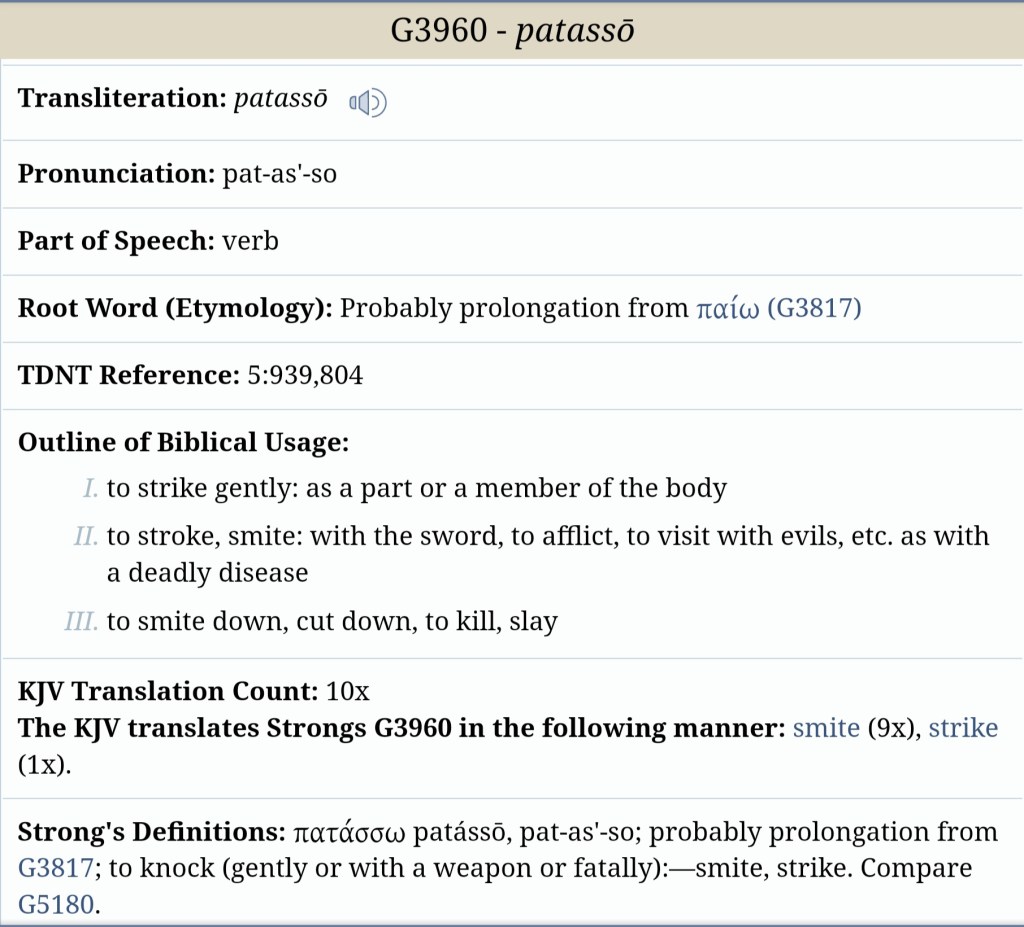
Update 05/16/2024: “And they smote the men that were at the door of the house with blindness, both small and great: so that they wearied themselves to find the door.” – Genesis 19:11 This smiting is “patasso” so remaining consistent that this is a justified smiting or “naka”.
Update 5/17/2024: After reviewing the 14 times that “typto” is used in the NT it seems to be in context of an unjust beating/smiting except 3 times. 2 of those three people were smiting their own breasts, and one time, Paul calls on God to smite (unjustly smite “typto”) one after he was unjustly smitten by that one. And “patasso” is translated 10 times in the NT and you can see in all cases it is easily argued as a just smiting. Jesus is smitten of the Lord (justly for our sins as He is taking our just punishment) and then one cuts off an ear when Jesus is unjustly being taken as prisoner, and the rest are just smitings.
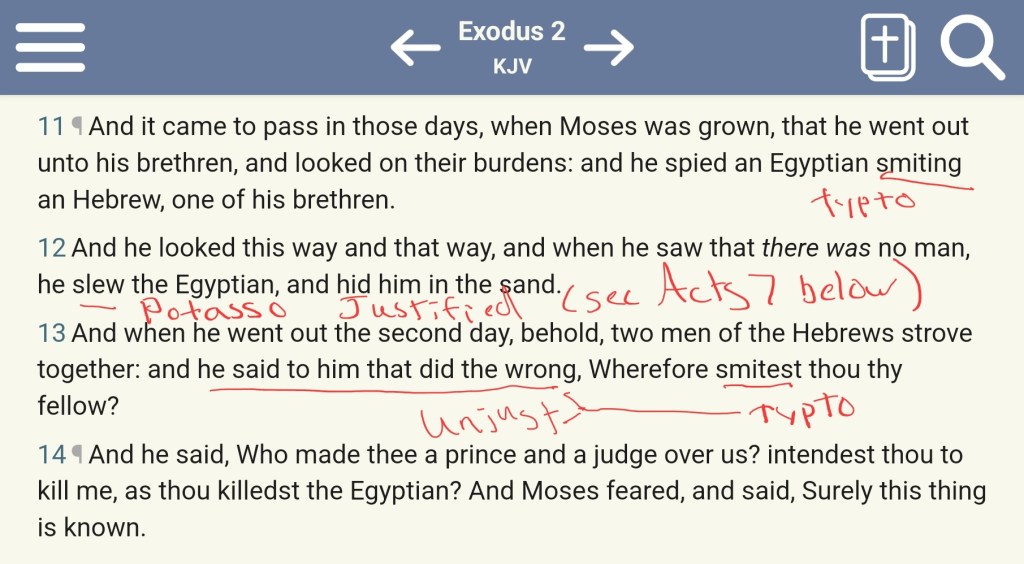
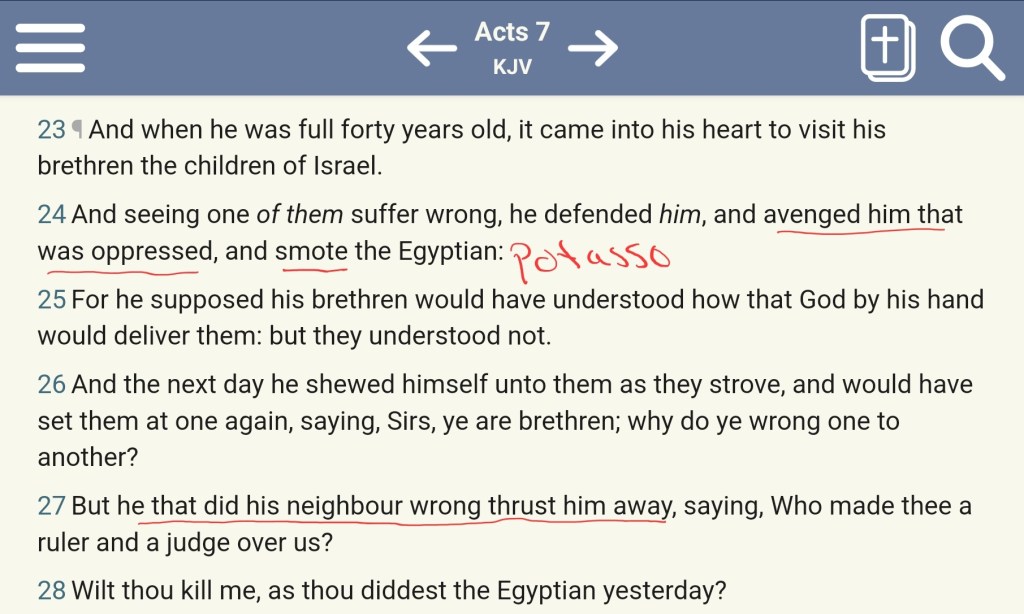
So far, it appears that “typto” is a use of force as is “patasso,” but “typto” is an unjustified use of force whereas “patasso” is a justified use of force.
Update 6/7/2024: First time “typto” is used in the OT is very telling and continues to be consistent with above understanding.
Just wanted to post these links here:
Who bought us..
Thy ransomed servant
Don’t labor in vain
 1love1god.com