Call us…Sarmenticii

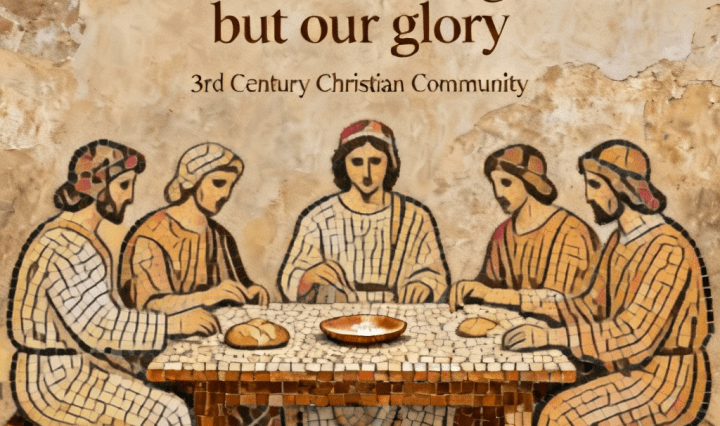
Sarmenticii – fagot people. But the day is won when the object of the struggle is gained. This victory of ours gives us the glory of pleasing God, and the spoil of life eternal. But we are overcome. Yes, when we have obtained our wishes. Therefore we conquer in dying; we go forth victorious at the very time we are subdued. Call us, if you like, Sarmenticii and Semaxii, because, bound to a half-axle stake, we are burned in a circle-heap of fagots. This is the attitude in which we conquer, it is our victory-robe, it is for us a … Continue reading Call us…Sarmenticii

The most good God

Moreover, it would be a more unworthy course for God to spare the evil-doer than to punish him, especially in the most good and holy God, who is not otherwise fully good than as the enemy of evil, and that to such a degree as to display His love of good by the hatred of evil, and to fulfil His defence of the former by the extirpation of the latter. Tertullian. 1885. “The Five Books against Marcion.” In Latin Christianity: Its Founder, Tertullian, edited by Alexander Roberts, James Donaldson, and A. Cleveland Coxe, translated by Peter Holmes, 3:292. The Ante-Nicene … Continue reading The most good God

That heresies should come

Come now, you who would indulge a better curiosity, if you would apply it to the business of your salvation, run over the apostolic churches, in which the very thrones of the apostles are still pre-eminent in their places, IN THEIR OWN AUTHENTIC WRITINGS ARE READ, uttering the voice and representing the face of each of them severally. Achaia is very near you, (in which) you find CORINTH. Since you are not far from Macedonia, you have PHILIPPI; (and there too) you have the THESSALONIANS. Since you are able to cross to Asia, you get EPHESUS. Since, moreover, you are … Continue reading That heresies should come

Thou hast the words of eternal life

No man gets instruction from that which tends to destruction. No man receives illumination from a quarter where all is darkness. Tertullian. 1885. “The Prescription against Heretics.” In Latin Christianity: Its Founder, Tertullian, edited by Alexander Roberts, James Donaldson, and A. Cleveland Coxe, translated by Peter Holmes, 3:249. The Ante-Nicene Fathers. Buffalo, NY: Christian Literature Company. “From that time many of his disciples went back, and walked no more with him. Then said Jesus unto the twelve, Will ye also go away? Then Simon Peter answered him, Lord, to whom shall we go? THOU HAST THE WORDS OF ETERNAL LIFE. … Continue reading Thou hast the words of eternal life

No watered down Christianity

What indeed has Athens to do with Jerusalem? What concord is there between the Academy and the Church? what between heretics and Christians? Our instruction comes from “the porch of Solomon,” who had himself taught that “the Lord should be sought in simplicity of heart.” Away with all attempts to produce a mottled Christianity of Stoic, Platonic, and dialectic composition! We want no curious disputation after possessing Christ Jesus, no inquisition after enjoying the gospel! With our faith, we desire no further belief. For this is our palmary faith, that there is nothing which we ought to believe besides. Tertullian. … Continue reading No watered down Christianity

We boldly assert and persistently maintain

As for our own views, indeed, we know what was man’s origin, and we boldly assert and persistently maintain that death happens not by way of natural consequence to man, but owing to a fault and defect which is not itself natural; although it is easy enough, no doubt, to apply the term natural to faults and circumstances which seem to have been (though from the emergence of an external cause) inseparable to us from our very birth. If man had been directly appointed to die as the condition of his creation, then of course death must be imputed to … Continue reading We boldly assert and persistently maintain

Jesus, Jesus, Jesus

“Each is asked to stand forth and sing, as he can, a hymn to God, either one from the holy Scriptures or one of his own composing” – Tertullian describing a 2nd century church service Tertullian. 1885. “The Apology.” In Latin Christianity: Its Founder, Tertullian, edited by Alexander Roberts, James Donaldson, and A. Cleveland Coxe, translated by S. Thelwall, 3:47. The Ante-Nicene Fathers. Buffalo, NY: Christian Literature Company. “Jesus, Jesus, Jesus; there’s just something about that nameMaster, Savior, Jesus, like the fragrance after the rain;Jesus, Jesus, Jesus, let all Heaven and earth proclaimKings and kingdoms will all pass awayBut there’s … Continue reading Jesus, Jesus, Jesus

We allow that life begins with conception

How, then, is a living being conceived? Is the substance of both body and soul formed together at one and the same time? Or does one of them precede the other in natural formation? We indeed maintain that both are conceived, and formed, and perfectly simultaneously, as well as born together; and that not a moment’s interval occurs in their conception, so that a prior place can be assigned to either. Judge, in fact, of the incidents of man’s earliest existence by those which occur to him at the very last. As death is defined to be nothing else than … Continue reading We allow that life begins with conception

Until we come…

“CHAP. XXVI.—SCRIPTURE ALONE OFFERS CLEAR KNOWLEDGE ON THE QUESTIONS WE HAVE BEEN CONTROVERTING Now there is no end to the uncertainty and irregularity of human opinion, until we come to the limits which God has prescribed. I shall at last retire within our own lines and firmly hold my ground there, for the purpose of proving to the Christian (the soundness of) my answers to the Philosophers and the Physicians. Brother (in Christ), on your own foundation build up your faith. Consider the wombs of the most sainted women instinct with the life within them, and their babes which not … Continue reading Until we come…