

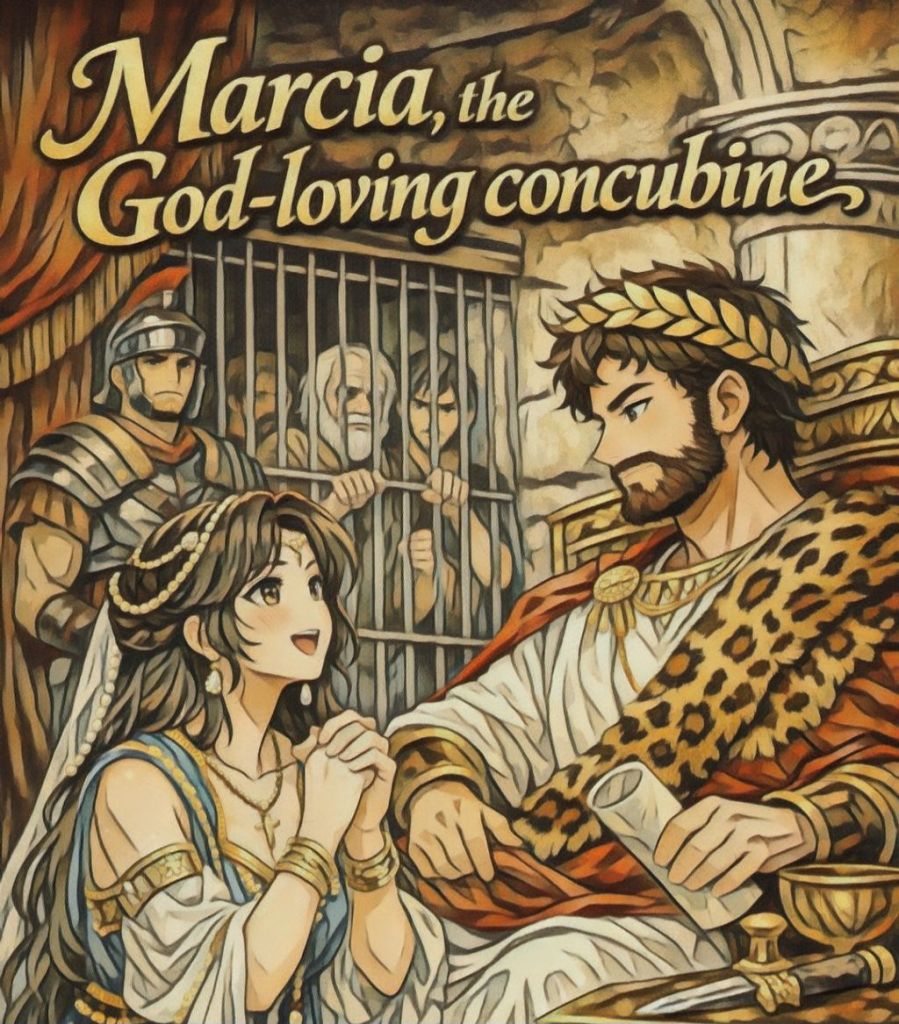
But after a time, there being in that place other martyrs, Marcia, a concubine of Commodus, who was a God-loving female, and desirous of performing some good work, invited into her presence the blessed Victor, who was at that time a bishop of the Church, and inquired of him what martyrs were in Sardinia. And he delivered to her the names of all, but did not give the name of Callistus, knowing the villanous acts he had ventured upon. Marcia, obtaining her request from Commodus, hands the letter of emancipation to Hyacinthus, a certain eunuch, rather advanced in life. And he, on receiving it, sailed away into Sardinia, and having delivered the letter to the person who at that time was governor of the territory, he succeeded in having the martyrs released, with the exception of Callistus. But Callistus himself, dropping on his knees, and weeping, entreated that he likewise might obtain a release. Hyacinthus, therefore, overcome by the captive’s importunity, requests the governor to grant a release, alleging that permission had been given to himself from Marcia (to liberate Callistus), and that he would make arrangements that there should be no risk in this to him. Now (the governor) was persuaded, and liberated Callistus also. And when the latter arrived at Rome, Victor was very much grieved at what had taken place; but since he was a compassionate man, he took no action in the matter.
Hippolytus of Rome. 1886. “The Refutation of All Heresies.” In Fathers of the Third Century: Hippolytus, Cyprian, Novatian, Appendix, edited by Alexander Roberts, James Donaldson, and A. Cleveland Coxe, translated by J. H. MacMahon, 5:129–30. The Ante-Nicene Fathers. Buffalo, NY: Christian Literature Company.
From Grok retranslated with some context:
A Dramatic Prison Release in Ancient Rome
This story takes place around the year 190 AD, during the rule of the Roman Emperor Commodus. At that time, Christians sometimes faced persecution. Some were sent to work as prisoners in the dangerous mines on the island of Sardinia (off the coast of Italy). The conditions there were brutal—bad air, hard labor, and many died.
A powerful woman named Marcia, who was a concubine (girlfriend) of Emperor Commodus, was kind toward Christians and wanted to help. She asked the Bishop of Rome, Victor (the leader of the Christian church in Rome at the time), for the names of the Christian prisoners in Sardinia so she could try to get them freed.
Bishop Victor gave her a list of the prisoners’ names. But he left out one name on purpose: Callistus. Victor knew Callistus had been involved in some serious wrongdoing earlier in his life (Hippolytus, who wrote this story, strongly disliked Callistus and described him as untrustworthy). Victor did not think Callistus deserved to be released with the others.
Marcia got permission from Commodus and sent a letter ordering the prisoners’ release. She gave the letter to an older man named Hyacinthus, a eunuch (a man who had been castrated, often serving in high positions at the emperor’s court). Hyacinthus sailed to Sardinia and handed the letter to the local governor.
The governor freed all the prisoners on the list. But Callistus, who was still there, got down on his knees, cried, and begged Hyacinthus to include him too. He pleaded desperately for freedom.
Hyacinthus felt sorry for him. Even though Callistus was not on the official list, Hyacinthus asked the governor to let him go anyway. He promised that Marcia’s influence with the emperor would protect the governor from any trouble. The governor agreed, and Callistus was released along with the others.
When Callistus returned to Rome, Bishop Victor was very upset. He knew Callistus’s past and felt it was wrong that he had been freed. However, Victor was a compassionate man. Instead of punishing Callistus or causing a big scene, he chose not to take any strong action against him.
Cool story and according to the scholars there is no reason to disbelieve this to be a true story.
Just some cool Christian history from back in the day
 1love1god.com