

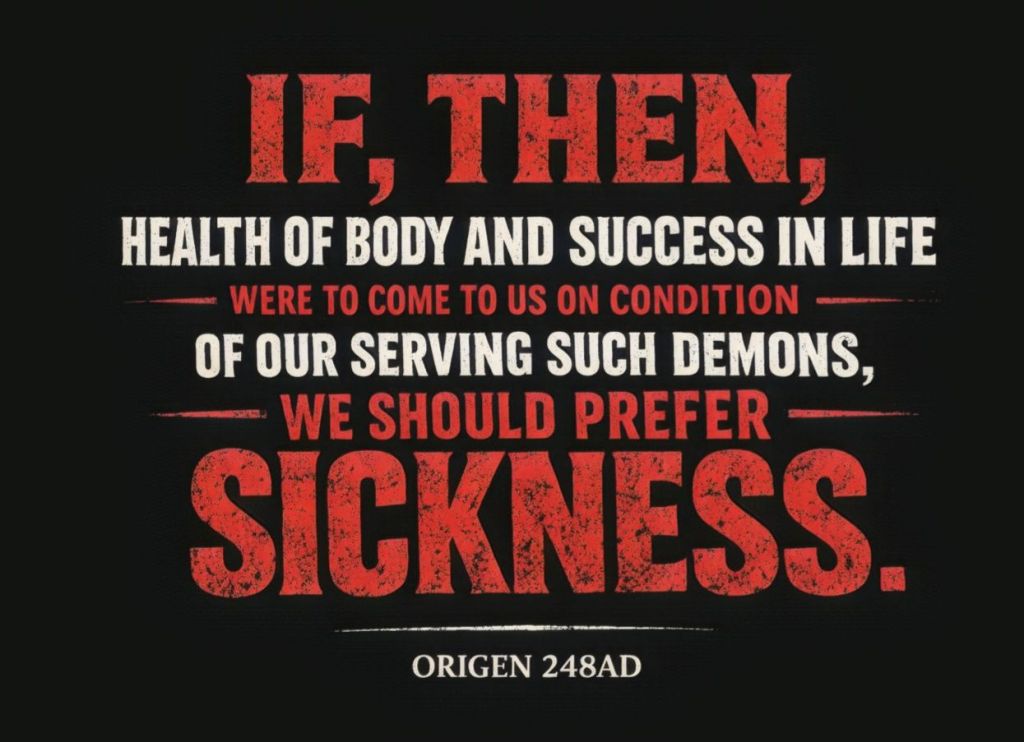
If Celsus had carefully weighed the meaning of the word “profitable,” and had considered that the truest profit lies in virtue and in virtuous action, he would not have applied the phrase “as far as it is profitable” to the service of such demons, as he has acknowledged them to be. If, then, health of body and success in life were to come to us on condition of our serving such demons, we should prefer sickness and misfortune accompanied with the consciousness of our being truly devoted to the will of God. For this is preferable to being mortally diseased in mind, and wretched through being separate and outcasts from God, though healthy in body and abounding in earthly prosperity. And we would rather go for help to one who seeks nothing whatever but the well-being of men and of all rational creatures, than to those who delight in blood and sacrificial odours.
Origen. 1885. “Origen against Celsus.” In Fathers of the Third Century: Tertullian, Part Fourth; Minucius Felix; Commodian; Origen, Parts First and Second, edited by Alexander Roberts, James Donaldson, and A. Cleveland Coxe, translated by Frederick Crombie, 4:663. The Ante-Nicene Fathers. Buffalo, NY: Christian Literature Company.
“Women received their dead raised to life again: and others were tortured, not accepting deliverance; that they might obtain a better resurrection: And others had trial of cruel mockings and scourgings, yea, moreover of bonds and imprisonment: They were stoned, they were sawn asunder, were tempted, were slain with the sword: they wandered about in sheepskins and goatskins; being destitute, afflicted, tormented; (Of whom the world was not worthy:) they wandered in deserts, and in mountains, and in dens and caves of the earth. And these all, having obtained a good report through faith, received not the promise: God having provided some better thing for us, that they without us should not be made perfect.” – Hebrews 11:35–40
 1love1god.com