
In the next place, since our opponents keep repeating those statements about faith, we must say that, considering it as a useful thing for the multitude, we admit that we teach those men to believe without reasons, who are unable to abandon all other employments, and give themselves to an examination of arguments; and our opponents, although they do not acknowledge it, yet practically do the same. For who is there that, on betaking himself to the study of philosophy, and throwing himself into the ranks of some sect, either by chance, or because he is provided with a teacher of that school, adopts such a course for any other reason, except that he believes his particular sect to be superior to any other? For, not waiting to hear the arguments of all the other philosophers, and of all the different sects, and the reasons for condemning one system and for supporting another, he in this way elects to become a Stoic, e.g., or a Platonist, or a Peripatetic, or an Epicurean, or a follower of some other school, and is thus borne, although they will not admit it, by a kind of irrational impulse to the practice, say of Stoicism, to the disregard of the others; despising either Platonism, as being marked by greater humility than the others; or Peripateticism, as more human, and as admitting with more fairness than other systems the blessings of human life. And some also, alarmed at first sight about the doctrine of providence, from seeing what happens in the world to the vicious and to the virtuous, have rashly concluded that there is no divine providence at all, and have adopted the views of Epicurus and Celsus.
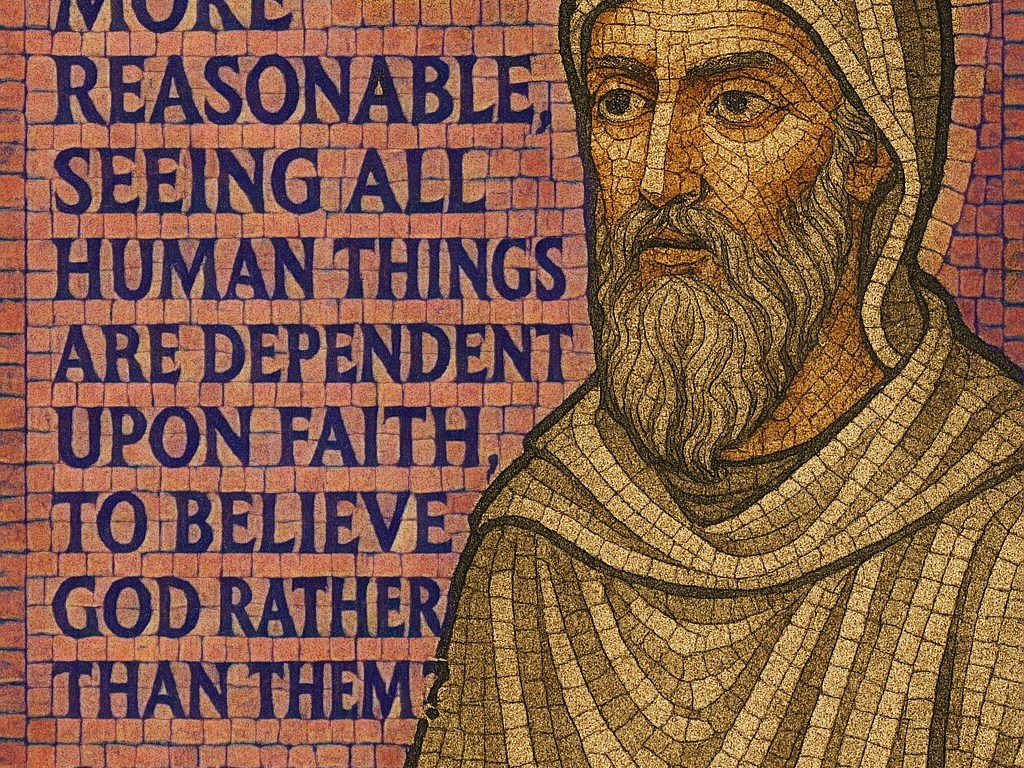
Since, then, as reason teaches, we must repose faith in some one of those who have been the introducers of sects among the Greeks or Barbarians, why should we not rather believe in God who is over all things, and in Him who teaches that worship is due to God alone, and that other things are to be passed by, either as non-existent, or as existing indeed, and worthy of honour, but not of worship and reverence? And respecting these things, he who not only believes, but who contemplates things with the eye of reason, will state the demonstrations that occur to him, and which are the result of careful investigation. And why should it not be more reasonable, seeing all human things are dependent upon faith, to believe God rather than them? For who enters on a voyage, or contracts a marriage, or becomes the father of children, or casts seed into the ground, without believing that better things will result from so doing, although the contrary might and sometimes does happen? And yet the belief that better things, even agreeably to their wishes, will follow, makes all men venture upon uncertain enterprises, which may turn out differently from what they expect. And if the hope and belief of a better future be the support of life in every uncertain enterprise, why shall not this faith rather be rationally accepted by him who believes on better grounds than he who sails the sea, or tills the ground, or marries a wife, or engages in any other human pursuit, in the existence of a God who was the Creator of all these things, and in Him who with surpassing wisdom and divine greatness of mind dared to make known this doctrine to men in every part of the world, at the cost of great danger, and of a death considered infamous, which He underwent for the sake of the human race; having also taught those who were persuaded to embrace His doctrine at the first, to proceed, under the peril of every danger, and of ever impending death, to all quarters of the world to ensure the salvation of men?
Origen. 1885. “Origen against Celsus.” In Fathers of the Third Century: Tertullian, Part Fourth; Minucius Felix; Commodian; Origen, Parts First and Second, edited by Alexander Roberts, James Donaldson, and A. Cleveland Coxe, translated by Frederick Crombie, 4:400–401. The Ante-Nicene Fathers. Buffalo, NY: Christian Literature Company.
Into modern english by Grok
Next, since our opponents keep hammering on about faith, we should respond like this: We do admit that faith is useful for most people. So we teach those who can’t drop everything else in life to devote themselves to examining arguments in detail—they simply believe without deep rational proofs. But our critics do exactly the same thing in practice, even if they won’t admit it.
Think about it: When someone decides to study philosophy and joins a particular school—whether by chance or because they happen to find a teacher from that group—what other reason do they have except believing that this sect is better than the others? They don’t wait to hear out the arguments from every philosopher or every school, or weigh all the reasons for rejecting one system and accepting another. Instead, they just pick one—like becoming a Stoic, a Platonist, a Peripatetic, an Epicurean, or a follower of some other group. They’re carried along by a kind of irrational impulse toward, say, Stoicism, while ignoring the rest. They dismiss Platonism as overly humble compared to others, or Peripatetic philosophy as too human-centered and overly generous in accepting the good things in ordinary life. Some people, shocked right away by what they see happening in the world—how bad things happen to good people and good things to bad—rashly conclude there’s no divine providence at all and jump to the views of Epicurus (or even Celsus himself).
So, since reason shows that we have to place our trust (pistis/faith) in one of the founders of the philosophical sects among the Greeks or barbarians, why shouldn’t we instead trust God—who rules over everything—and the one who teaches that worship belongs to God alone? Everything else should be set aside: either as non-existent, or as things that do exist and deserve some honor, but not worship or divine reverence.
Someone who not only believes but also examines things rationally will be able to provide the proofs that come to mind from careful investigation. And since everything in human life depends on faith anyway, why isn’t it more reasonable to put our faith in God rather than in these human teachers?
After all, who sets out on a sea voyage, gets married, has children, or sows seed in the ground without believing they’ll get better results—even though the opposite can and sometimes does happen? Yet the hope and belief that things will turn out well (as they wish) is what drives people to take on all these uncertain ventures, even when outcomes can differ from expectations. If hope and belief in a better outcome sustain life in every risky human endeavor, why shouldn’t this kind of faith be accepted even more rationally by someone who has stronger grounds for belief than the sailor, the farmer, the husband, or anyone else in ordinary pursuits?
That stronger ground is belief in a God who created all these things, and in the one who—with extraordinary wisdom and divine nobility of soul—dared to proclaim this teaching to people everywhere in the world. He did so at great personal risk, even enduring a death that society saw as shameful, all for the sake of humanity. He also instructed those who first accepted his message to go out—despite every danger and the constant threat of death—to every corner of the world to bring about the salvation of humankind.
 1love1god.com