


From Grok but always fact check your AI and God bless
The earliest archaeological mentions of King David (or more precisely, references to him or his dynasty) come from extrabiblical inscriptions, as no direct contemporary inscriptions from David’s lifetime (traditionally dated to around the early 10th century BCE, ca. 1010–970 BCE) have been found naming him personally.
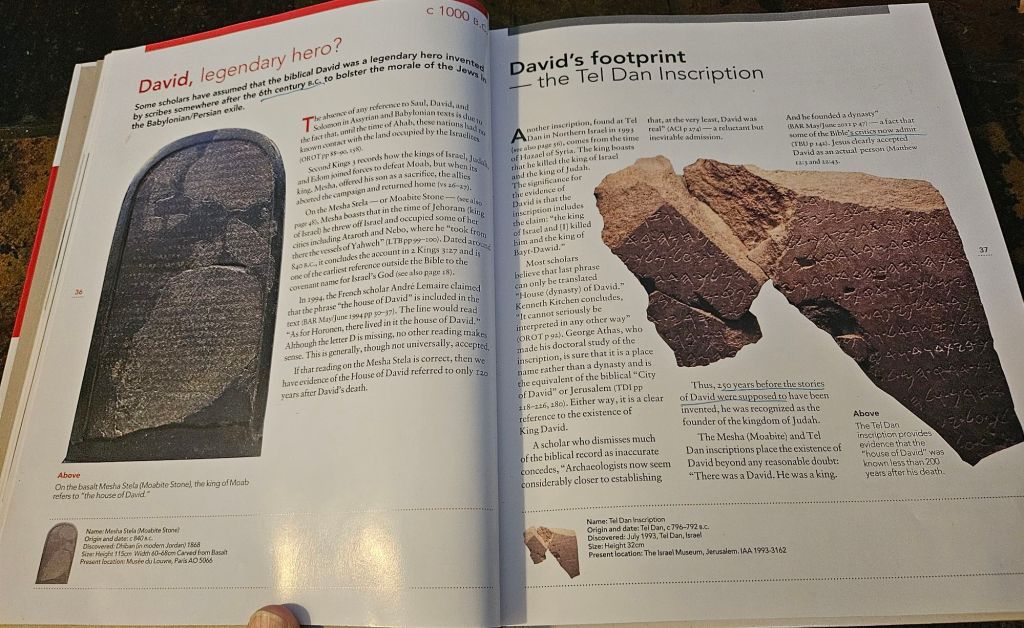
The most widely accepted and earliest confirmed reference is the Tel Dan Stele, a basalt stone inscription discovered in 1993 at Tel Dan in northern Israel. It dates to the mid-9th century BCE (around 841–800 BCE), roughly 150–200 years after David’s reign. Written in Old Aramaic by an Aramean king (likely Hazael or his son), it boasts of victories over the “king of Israel” and the “king of the House of David” (bytdwd in the script). This phrase refers to the dynasty or kingdom founded by David, making it the first clear extrabiblical evidence that David was recognized as a historical figure and the founder of Judah’s royal line. Scholars generally accept this reading as authentic and referring to the biblical David.
(Here is an image of the Tel Dan Stele fragments, showing the key “House of David” portion.)
A potential earlier candidate is the Mesha Stele (also known as the Moabite Stone), discovered in the 19th century and dated to around the mid-9th century BCE (similar timeframe to the Tel Dan Stele, ca. 840 BCE). It records victories by King Mesha of Moab over Israel. In line 31, a damaged section has been interpreted by some scholars (notably André Lemaire in 1994, with further support from recent imaging and studies in the 2020s) as another reference to the “House of David” (bytdwd). This would make it roughly contemporary with or possibly slightly earlier than Tel Dan, but the reading remains more debated and less universally accepted than Tel Dan’s due to the damage and alternative proposed readings (e.g., involving “Balak” or other terms).
No earlier inscriptions (from the 10th century BCE or David’s own era) directly mention David or his house. Other sites like Khirbet Qeiyafa (dated to ca. 1020–975 BCE, overlapping David’s time) provide indirect support for a Judahite kingdom in the 10th century BCE through fortifications, inscriptions, and material culture, but they do not name David himself.
In summary, the Tel Dan Stele provides the earliest unambiguous archaeological mention of David (via his dynasty), dating to the 9th century BCE, with the Mesha Stele as a possible near-contemporary parallel. These discoveries shifted scholarly consensus toward viewing David as a historical king rather than purely a legendary figure.
 1love1god.com