

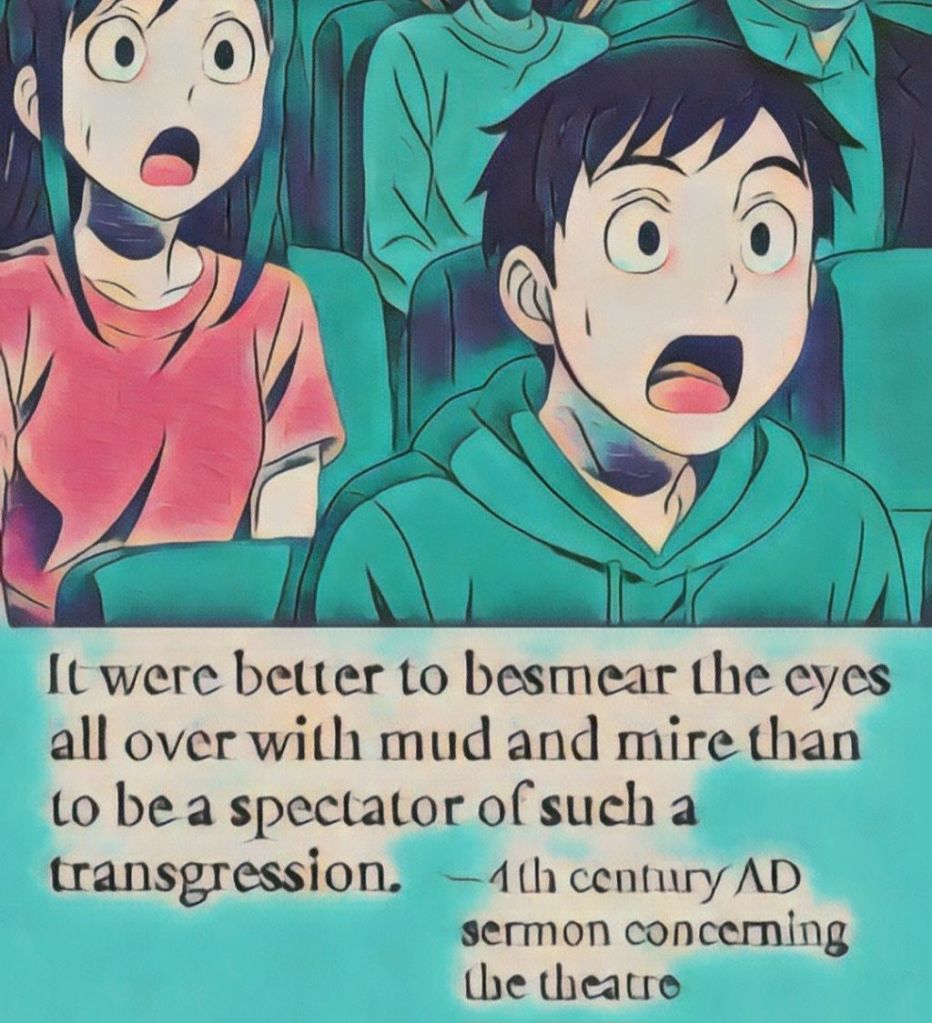
From John Chrysostom in 386ish AD. He seems to be a respected 4th century bishop respected by Catholic, Orthodox and Protestants. Considered to be one of the greatest preachers in Christian history. What little I know about the period in which he preached was during a time that Christianity after 300 years of on and off persecution gains success and some ease of living and support even from the state which never happened before and may explain some of the preaching and concern he had for the church as new temptations arose with this new found freedom. But I am no historian and feel free to correct me or add to my comments. God bless….
“And this I say, not freeing them from reproof, but that ye may learn that it is you chiefly who supply the principle and root of such lawlessness; ye who consume your whole day on these matters, and profanely exhibit the sacred things of marriage, and make an open mock of the great mystery. For not even he who acts these things is so much the offender, as thou art before him; thou who biddest him make a play on these things, or rather who not only biddest him, but art even zealous about it, taking delight, and laughing, and praising what is done, and in every way gaining strength for such workshops of the devil.
Tell me then, with what eyes wilt thou after this look upon thy wife at home, having seen her insulted there? Or how dost thou not blush being put in mind of the partner of thy home, when thou seest nature herself put to an open shame? Nay, tell me not, that what is done is acting; for this acting hath made many adulterers, and subverted many families. And it is for this most especially that I grieve, that what is done doth not so much as seem evil, but there is even applause and clamor, and much laughter, at commission of so foul adultery. What sayest thou? that what is done is acting? Why, for this selfsame reason they must be worthy of ten thousand deaths, that what things all laws command men to flee, they have taken pains to imitate. For if the thing itself be bad, the imitation thereof also is bad. And I do not yet say how many adulterers they make who act these scenes of adultery, how they render the spectators of such things bold and shameless; for nothing is more full of whoredom and boldness than an eye that endures to look at such things.
And thou in a market-place wouldest not choose to see a woman stripped naked, or rather not even in a house, but callest such a thing an outrage. And goest thou up into the theatre, to insult the common nature of men and women, and disgrace thine own eyes? For say not this, that she that is stripped is an harlot; but that the nature is the same, and they are bodies alike, both that of the harlot, and that of the freewoman. For if this be nothing amiss, what is the cause that if thou were to see this done in a market place, thou wouldest both hasten away thyself, and drive thence her who was behaving herself unseemly? Or is it that when we are apart, then such a thing is outrageous, but when we are assembled and all sitting together, it is no longer equally shameful? Nay, this is absurdity and a disgrace, and words of the utmost madness; and it were better to besmear the eyes all over with mud and mire than to be a spectator of such a transgression. For surely mire is not so much an hurt to an eye, as an unchaste sight, and the spectacle of a woman stripped naked.
Hear, for example, what it was that caused nakedness at the beginning, and read the occasion of such disgrace. What then did cause nakedness? Our disobedience, and the devil’s counsel. Thus, from the first, even from the very beginning, this was his contrivance. Yet they were at least ashamed when they were naked, but ye take a pride in it; “having,” according to that saying of the apostle, “your glory in your shame.”
How then will thy wife thenceforward look upon thee, when thou art returned from such wickedness? how receive thee? how speak to thee, after thou hast so publicly put to shame the common nature of woman, and art made by such a sight the harlots’ captive and slave?
Now if ye grieve at hearing these things, I thank you much, for “who is he that maketh me glad, but he which is made sorry by me?” Do not then ever cease to grieve and be vexed for them, for the sorrow that comes of such things will be to you a beginning of a change for the better. For this cause I also have made my language the stronger, that by cutting deeper I might free you from the venom of them that intoxicate you; that I might bring you back to a pure health of soul; which God grant we may all enjoy by all means, and attain unto the rewards laid up for these good deeds; by the grace and love towards man of our Lord Jesus Christ, to whom be glory and dominion forever and ever. Amen.”
John Chrysostom. 1888. “Homilies of St. John Chrysostom, Archbishop of Constantinople on the Gospel according to St. Matthew.” In Saint Chrysostom: Homilies on the Gospel of Saint Matthew, edited by Philip Schaff, translated by George Prevost and M. B. Riddle, 10:42–43. A Select Library of the Nicene and Post-Nicene Fathers of the Christian Church, First Series. New York: Christian Literature Company.
“I will sing of mercy and judgment: Unto thee, O LORD, will I sing. I will behave myself wisely In a perfect way. O when wilt thou come unto me? I will walk within my house with a perfect heart. I will set no wicked thing before mine eyes: I hate the work of them that turn aside; It shall not cleave to me.” – Psalm 10:1-3
“I made a covenant with mine eyes; Why then should I think upon a maid?” – Job 31:1
“Ye have heard that it was said by them of old time, Thou shalt not commit adultery: but I say unto you, That whosoever looketh on a woman to lust after her hath committed adultery with her already in his heart. And if thy right eye offend thee, pluck it out, and cast it from thee: for it is profitable for thee that one of thy members should perish, and not that thy whole body should be cast into hell. And if thy right hand offend thee, cut it off, and cast it from thee: for it is profitable for thee that one of thy members should perish, and not that thy whole body should be cast into hell.” – Matthew 5:27-30
“And she shall bring forth a son, and thou shalt call his name JESUS: for he shall save his people from their sins.” – Matthew 1:21
“And the grace of our Lord was exceeding abundant with faith and love which is in Christ Jesus. This is a faithful saying, and worthy of all acceptation, that Christ Jesus came into the world to save sinners; of whom I am chief. Howbeit for this cause I obtained mercy, that in me first Jesus Christ might shew forth all longsuffering, for a pattern to them which should hereafter believe on him to life everlasting. Now unto the King eternal, immortal, invisible, the only wise God, be honour and glory for ever and ever. Amen.” – 1 Timothy 1:14-17
 1love1god.com