

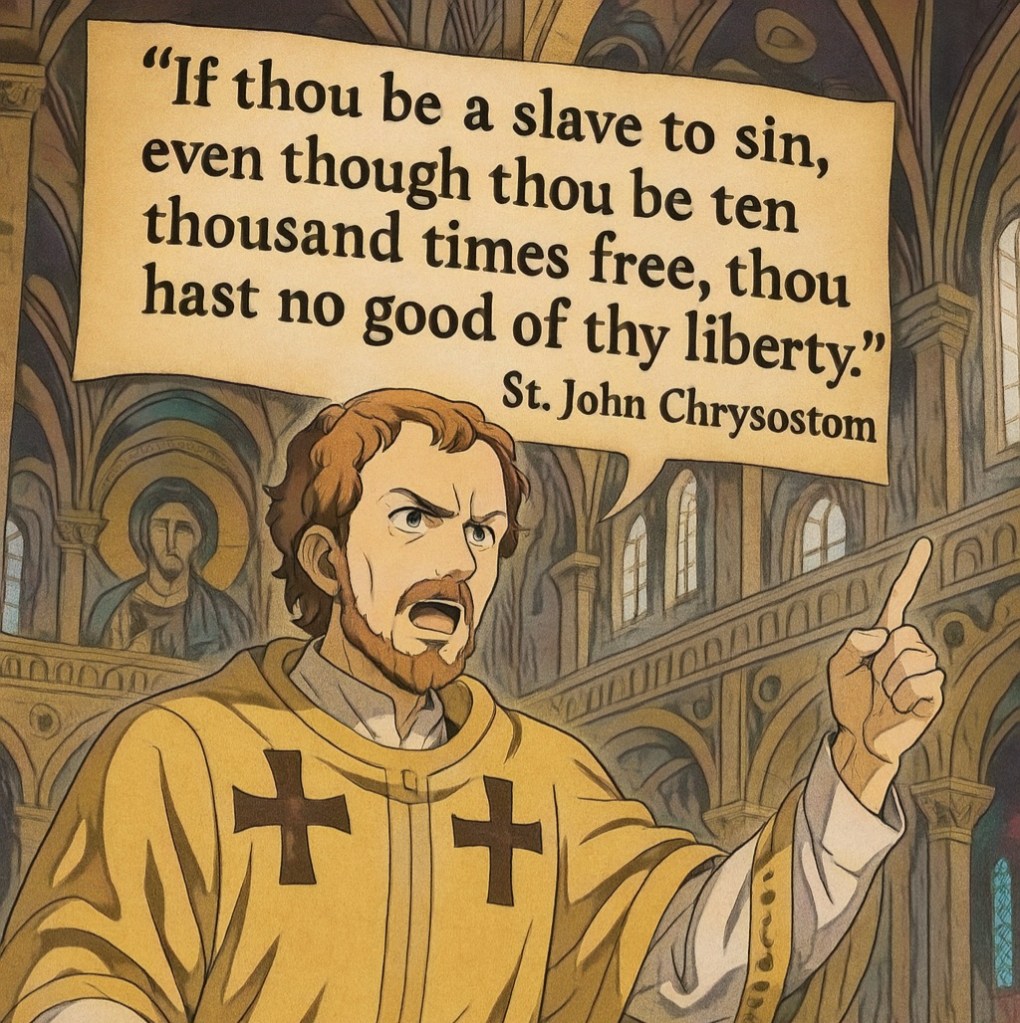
3rd century Christian commentary 1 Corinthians 7:23 arguing that there is more freedom for a believer in Christ who is a slave than a thousand free men and women but in bondage to sin.
“This saying is addressed not to slaves only, but also to free men. For it is possible for one who is a slave not to be a slave; and for one who is a free man to be a slave. “And how can one be a slave and not a slave?” When he doeth all for God: when he feigns nothing, and doeth nothing out of eye-service towards men: that is how one that is a slave to men can be free. Or again, how doth one that is free become a slave? When he serves men in any evil service, either for gluttony, or desire of wealth, or for office’ sake. For such an one, though he be free, is of a more slavish sort than all men.
And consider both these points. Joseph was a slave, but not a slave to men: wherefore even in slavery he was freer than all that are free. For instance, he yielded not to his mistress; yielded not to the purposes which she who possessed him desired. Again, she was free; yet none ever so like a slave, courting and beseeching her own servant. But she prevailed not on him, who was free, to do what he would not. This then was not slavery; but it was liberty of the most exalted kind. For what impediment to virtue had he from his slavery? Let men hear, both slaves and free. Which was the slave? He that was entreated, or she that did entreat? She that besought, or he that despised her supplication?
In fact, there are limits set to slaves by God Himself; and up to what point one ought to keep them, this is also exacted, and to transgress them is wrong. Namely, when your master commands nothing which is unpleasing to God, it is right to follow and to obey; but no farther. For thus the slave becomes free. But if you go further, even though you are free, you are become a slave. At least he intimates this, saying, Be not ye the servants of men.
But if this be not the meaning, if he bade them forsake their masters, and strive contentiously to become free, in what sense did he exhort them, saying, Let every one remain in the calling in which he is called? And in another place, As many servants as are under the yoke, let them count their own masters worthy of all honour; and those that have believing masters, let them not despise them, because they are brethren who partake of the benefit. And writing to the Ephesians also, and Colossians, he ordains and exacts the same rules. Whence it is plain, that it is not this slavery which he annuls, but that which, caused as it is by vice, befals free men also: and this is the worst kind of slavery, though he be a free man who is in bondage to it. For what profit had Joseph’s brethren of their freedom? Were they not more servile than all slaves; both speaking lies to their father, and to the merchants using false pretences, as well as to their brother? But not such was the free man: rather every where and in all things he was true. And nothing had power to enslave him, neither chain, nor bondage, nor the love of his mistress, nor his being in a strange land. But he abode free every where. For this is liberty in the truest sense, when even in bondage it shines through.
Such a thing is Christianity; in slavery to bestow freedom. And as that which is by nature an easily vulnerable body then shews itself to be invulnerable, when having received a dart it suffers no harm; so also he that is strictly free then shews himself, when even under masters he is not enslaved. For this cause his bidding is, “remain a slave.” But if it is impossible for one who is a slave to be a Christian such as he ought to be, the Greeks will condemn true religion of great weakness: whereas, if they can be taught that slavery in no way impairs godliness, they will admire our doctrine. For if death hart us not, nor scourges, nor chains, much less slavery. Fire, and iron, and tyrannies innumerable, and diseases, and poverty, and wild beasts, and countless things more dreadful than these, have not been able to injure the faithful men; nay, they have made them even mightier. And how shall slavery be able to hurt? It is not slavery itself, beloved, that hurts; but the real slavery is that of sin. And if thou be not a slave in this sense, be bold and rejoice. No one shall have power to do thee any wrong, having the temper which cannot be enslaved. But if thou be a slave to sin, even though thou be ten thousand times free, thou hast no good of thy liberty.
For, tell me, what profit is it, when, though not in bondage to a man, thou liest down in subjection to thy passions? Since men indeed often know how to spare; but those masters are never satiated with thy destruction. Art thou in bondage to a man? Why, thy master also is slave to thee, in arranging about thy food, in taking care of thy health, and clothes, and in looking after thy shoes, and all the other things. And thou dost not fear so much lest thou shouldest offend thy master, as he fears lest any of those necessaries should fail thee. “But he sits down, while thou standest.” And what of that? Since this may be said of thee as well as of him. Often, at least, when thou art lying down and sleeping sweetly, he is not only standing, but undergoing endless discomforts, in the market-place; and he lies awake more painfully than thou.
For instance; what did Joseph suffer from his mistress to be compared with what she suffered from her evil desire? For he indeed did not the things which she wished to put upon him; but she performed every thing which her mistress ordered her, I mean her spirit of unchastity: which left not off until it had put her to open shame. What master commands such things? what savage tyrant? “Intreat thy slave,” that is the word: “flatter the person bought with thy money, supplicate the captive; even if he reject thee with disgust, again besiege him: even if thou speakest to him oftentimes, and he consent not, watch for his being alone, and force him, and become an object of derision.” What can be more dishonourable, what more shameful, than these words? “And if even by these means you make no progress, why, accuse him falsely, and deceive your husband.” Mark how mean, how shameful are the commands, how unmerciful, and savage, and frantic. What command does the master ever lay on his slave, such as those which her wantonness then laid upon that royal woman? And yet she dared not disobey. But Joseph underwent nothing of this sort, but every thing on the contrary which brought glory and honour.
Would you like to see yet another man under severe orders from a hard mistress, and without spirit to disobey any of them? Consider Cain, what commands were laid on him by his envy. She ordered him to slay his brother, to lie unto God, to grieve his father, to cast off shame; and he did it all, and in nothing refused to obey. And why marvel, that over a single person so great should be the power of this mistress? She hath often destroyed entire nations. For instance, the Midianitish women took the Jews and all but bound them in captivity; their own beauty kindling desire, was the means of their vanquishing that whole nation. Paul then, to cast out this sort of slavery, said, Become not servants of men; that is, “Obey not men commanding unreasonable things: nay, obey not yourselves.” Then having raised up their mind, and made it mount on high, he says” – Homily by John Chrystosum
 1love1god.com