

“Thus saith the LORD of hosts, the God of Israel; Take these evidences, this evidence of the purchase, both which is sealed, and this evidence which is open; and put them in an earthen vessel, that they may continue many days.” – Jeremiah 32:14
“The scrolls are like a time machine, according to Popović, because they let scholars see what people were reading, writing and thinking at the time. “They are physical, tangible evidence of a period of history that is crucial — whether you’re Christian, Jewish or don’t believe at all, because the Bible is one of the most influential books in the history of the world, so the scrolls allow us to study it as a form of cultural evolution,” he said…..
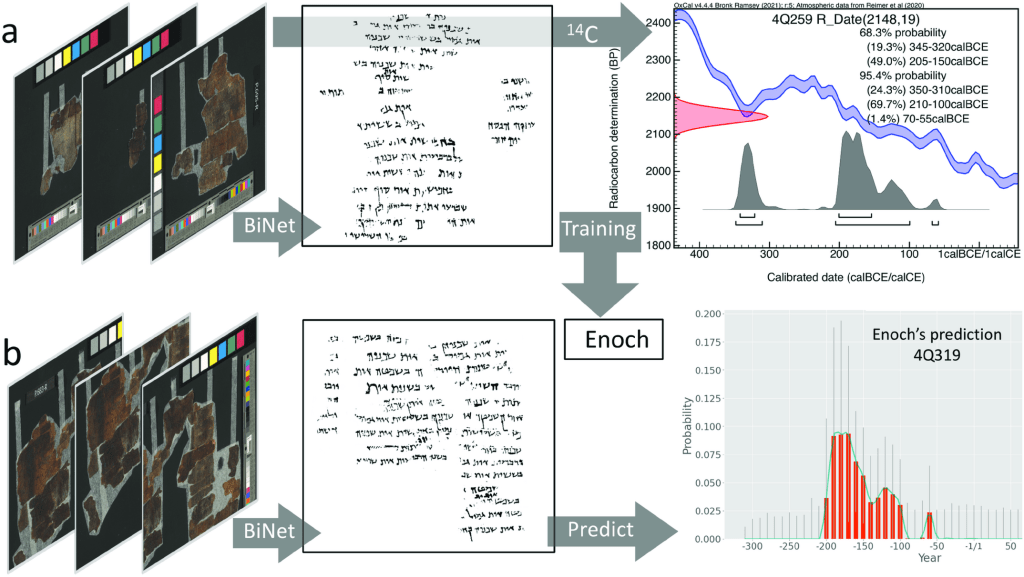
Another manuscript, with verses from the Book of Ecclesiastes, also dates older, Popović added. “The manuscript was previously dated on paleographic grounds to 175 to 125 BCE, but now Enoch suggests 300 to 240 BCE,” he said.”
https://journals.plos.org/plosone/article?id=10.1371/journal.pone.0323185
“Scholars often assume that the rise and expansion of the Hasmonaean kingdom from the mid-second century BCE onward caused a rise in literacy and gave a push to scribal and intellectual culture. Yet, the results of this study attest to the copying of multiple literary manuscripts before this period. One example is 4Q109, a copy of the biblical book of Ecclesiastes, a book which scholars tentatively date to the end of the third century BCE [15], for which Enoch gives a third-century BCE date prediction (S7 Appendix), close to Archaic-type manuscripts such as 4Q52 and 4Q70—copies of the biblical books of Samuel and Jeremiah.
Fourth, this study’s 14C result for 4Q114 and Enoch’s date prediction for 4Q109 now establish these to be the first known fragments of a biblical book from the time of their presumed authors [15].”
The results of this study thus dismantle unsubstantiated historical suppositions and chronological limitations, and call into question the validity of the default model’s relative typology. This relative typology can only be maintained with restrictions. The spread of the Hasmonaean-type manuscripts over the timeline does not affect the default relative typology in a major way, but the older, second-century BCE date ranges of the Herodian-type manuscripts challenge the relative typology. More research is needed to solve this issue.
 1love1god.com